The MERLIN project (2021–2026) is a major EU initiative supporting large-scale restoration of wetlands, rivers, and peatlands in line with the European Green Deal. Although peat extraction covers only a small share of European peatlands, the sector provides valuable expertise, technology, and experience for restoration efforts.
MERLIN highlights that peatland restoration should go beyond individual sites and be implemented at landscape level. Nature-based solutions, especially rewetting after extraction, play a key role in enhancing carbon storage, biodiversity, and climate resilience.
To scale up restoration, the project identifies the need for stronger policy frameworks, economic incentives, and cross-sector collaboration. Key challenges include regulatory barriers, fragmented land ownership, and administrative complexity.
Overall, MERLIN shows that successful peatland restoration requires coordinated action across sectors, with the peat industry acting as an important practical partner in the transition.

MERLIN project supports upscaling peatland restoration
The MERLIN project (Mainstreaming Ecological Restoration of Freshwater-Related Ecosystems in a Landscape Context: Innovation, Upscaling and Transformation) is a major Horizon 2020 initiative running from 2021 to 2026. With 47 partners across Europe, including IPS, MERLIN supports the implementation of the European Green Deal, while contributing to the EU Water Framework Directive and the Nature Restoration Law.
Backed by a €10 million budget, MERLIN works across economic sectors such as peat extraction, agriculture, hydropower, navigation, insurance, and water supply, while placing a strong emphasis on restoring wetlands, rivers, streams, and peatlands within a wider landscape context.
Engaging peat extraction sectors expertise for upscaling peatland restoration
Historically, large areas of Europe’s peatlands have been drained and converted for agriculture and forestry, while others remain in a near-natural state and are protected. Only around 0.4% of European peatlands are currently used for peat extraction, and extraction on one location generally lasts for decades. Primarily, these extraction sites are located on previously degraded land.
Extracted peat is mainly used in horticulture, supporting food production and ornamental plants. Smaller volumes are used for animal bedding, energy, and a range of industrial applications including construction materials, filters, cosmetics, chemicals, and medicinal products.
Once peat extraction ends, after-use obligations require new purposes for these sites. These often include:
- Rewetting to enable carbon accumulation and habitat restoration for peatland flora and fauna,
- Production of food, raw materials (including afforestation) or renewable energy supporting local livelihoods
- Water bodies for recreational activities.
Over decades, the peat extraction sector has developed strong technical expertise, specialized machinery, and a skilled workforce capable of working effectively on peatlands and their after-use. Importantly, the sector also recognizes the need to mitigate unavoidable environmental impacts.
Peat extraction sector supporting peatlands restoration
Therefore, IPS members have applied their peatland and peat experience, global networks and knowledge to develop two closely linked peat extraction sector related MERLIN deliverables:
- D 4.4 Value Chain Analysis in Key Economic Sectors
- D 4.5 Peat Extraction Sector Strategy: Upscaling peatland restoration through nature-based solutions in the landscape.
Although peat extraction sites represent only a small fraction of Europe’s peatlands in need of restoration, the sector is an important source of practical restoration knowledge and techniques that can also be applied beyond extraction site boundaries.
To develop these deliverables, three sectorial roundtables were conducted between 2022-2024 bringing together 62 participations by private and non-governmental organisations working with peat extraction. Peat extraction companies and their European and national umbrella organisations are core stakeholders in MERLIN’s Community of Practice, helping to develop climate‑ and nature‑friendly after‑use of former extraction sites and supporting wider landscape‑level collaboration.
Nature‑Based Solutions Across the Peat Value Chain
The Value Chain Analysis concluded that nature‑based solutions (NbS) in peat extraction are most often implemented during the pre‑ and post‑extraction phases. These solutions leverage ecosystem services to:
- Restore degraded peatlands
- Enhance carbon sequestration
- Improve biodiversity
- Strengthen climate resilience
To fully understand both the environmental impacts and the economic relevance of peat extraction, the entire value chain must be analysed. During the extraction phase, NbS are increasingly incorporated through voluntary certification schemes such as Responsibly Produced Peat (RPP) in Europe and Veriflora in North America, which aim to ensure that conditions at extraction sites are improved compared to their pre‑extraction state.
The Value Chain Analysis supports the further uptake of these certification standards and highlights their role in raising awareness of restoration needs and opportunities for large‑scale peatland recovery. Please read more from the Value Chain document.
A Strategy to Upscale Peatland Restoration Beyond Extraction Sites
MERLIN’s peat extraction–related deliverables support rewetting and restoration as a preferred after‑use of extraction sites wherever possible. Crucially, they also address how peatland restoration can be scaled up beyond site boundaries to the landscape level.
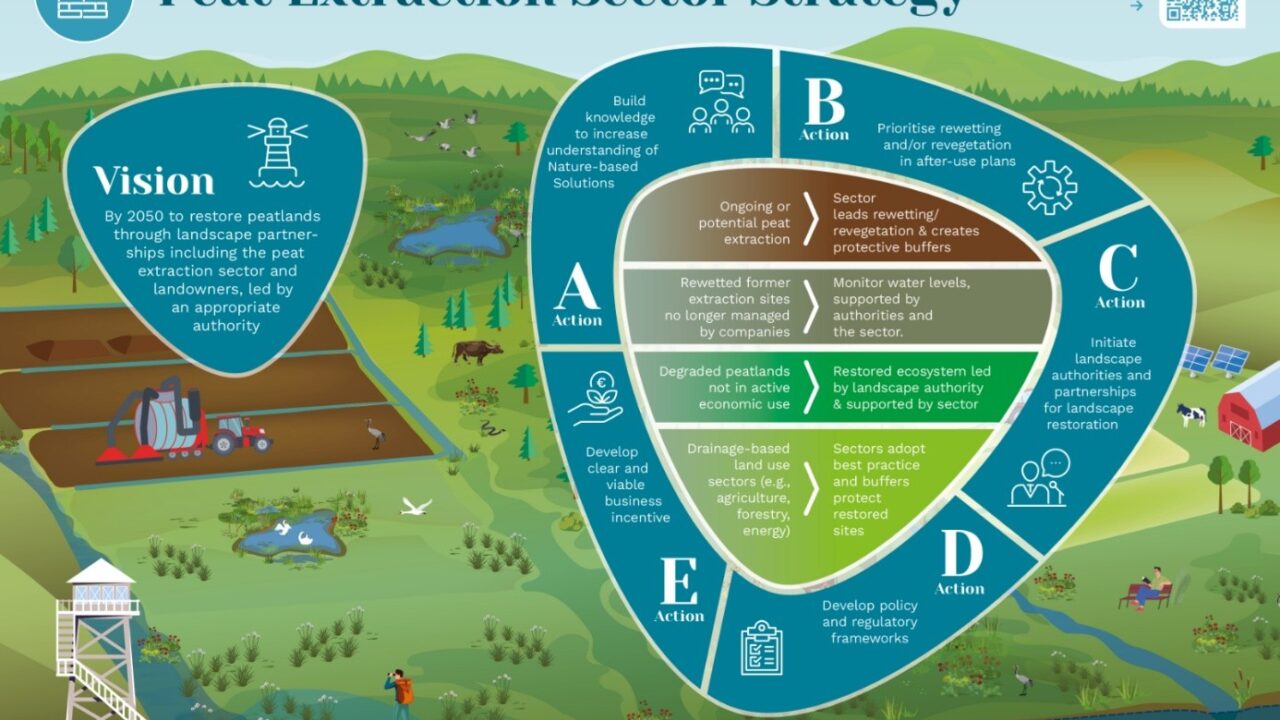
The Peat Extraction Sector Strategy aims at prioritizing peatland rewetting and restoration where appropriate and engaging peat extraction sector’s practical experience, knowledge and technical capacities to support the upscaling of peatland restoration beyond the borders of the extraction site to landscape level. For that peatland restoration initiatives and business opportunities must be developed. Issues such as regulatory constraints, limited funding, fragmented land ownership, competing land-use priorities, and complex landscapes that hinder large-scale peatland restoration. Overcoming these barriers is essential to enable the peat extraction sector’s full participation in large‑scale restoration initiatives.
The Peat Extraction Sector Strategy identifies five key actions:
- Build knowledge to increase understanding of nature-based solutions for peatland restoration and its implications for the peat extraction sector.
- Enhance after-use plans to prioritise rewetting and revegetation of peat extraction sites.
- Initiate landscape authorities and partnerships to embed rewetting and revegetation of peat extraction sites to support landscape restoration and good-practice peatland management.
- Develop policy and regulatory frameworks to enable landscape scale peatland restoration as a core licensing requirement.
- Develop clear and viable business incentive enabling the peat extraction sector to support restoration beyond the peat extraction site.
In the short term, implementation plans clarifying stakeholder roles and responsibilities are needed, alongside continued and strengthened engagement within the Community of Practice and across sectors. Public awareness also needs to be raised. In the long term, stable financial and regulatory support will be essential to sustain restoration efforts and support sectoral transition.
Lessons from MERLIN case studies
Restoration actions and experience from MERLIN case studies broadly support the strategic analyses developed within the project. In total, 3,514 hectares of wetlands and peatlands previously affected by drainage‑related land use—including agriculture, forestry, and peat extraction—were restored through MERLIN (from a total restored area of approximately 10,000 hectares).
Seven out of 18 case studies focused specifically on peatlands and wetlands, highlighting their importance within MERLIN. These case studies were located in Forth Basin (UK), Hutovo Blato (Bosnia and Herzegovina), Lima (Portugal), Kampinos (Poland), Komppasuo (Finland), Kvorning (Denmark), Beaver River (Sweden). All case studies are available in the MERLIN Case Study Portal.
Across case studies, a recurring challenge was the heavy administrative burden associated with restoration planning. Lengthy permitting processes and extensive paperwork often delayed implementation. Other challenges included:
- Limited long‑term monitoring to assess restoration impacts
- Interannual environmental variability
- Technical difficulties caused by high water levels, such as restricted access or stuck machinery
These experiences highlight the importance of flexibility, stakeholder cooperation, and patience. Existing environmental values must also be safeguarded during restoration, which can limit the choice of locations, technical solutions, and timing. A key conclusion across case studies was that, while funding is essential, it is not always the main bottleneck for successful restoration.
MERLIN peatland related materials
Ibrahim A., Blackstock K., Rieley Jack., Purre A., Berglund Ö. 2025. Peat extraction sector strategy: Upscaling peatland restoration through nature-based solutions in the landscape. EU H2020 research and innovation project MERLIN Deliverable 4.5. 55 pp. https://project-merlin.eu/outcomes/sectoral-activity/peat-extraction.html
Räsänen, A., Albrecht, E., Annala, M., Aro, L., Laine, A. M., Maanavilja, L., Mustajoki, J., Ronkanen, A.-K., Silvan, N., Tarvainen, O., Tolvanen, A. (2023) After-use of peat extraction sites – A systematic review of biodiversity, climate, hydrological and social impacts. Science of the Total Environment, 882, 163583. https://doi.org/10.1016/j.scitotenv.2023.163583
Rankinen, K., Futter, M., Bhattacharjee, J., Cano Bernal, J. E., Lannergård, E. E., Ojanen, M., Ronkanen, A.-K., Marttila, H., Hellsten, S. (2023) Influence of forest management changes and reuse of peat production areas on water quality in a northern river. Catena, 226, 107045. https://doi.org/10.1016/j.catena.2023.107045
Manolaki, P., Riis, T., Hyttel, O., Baumane, M., Baattrup-Pedersen, A. (2025) Climate mitigation potential of peatland rewetting in Denmark: Plant biomass harvesting as a measure to reduce phosphorus runoff. Journal of Environmental Management, 395, 127974. https://doi.org/10.1016/j.jenvman.2025.127974